The Hook
Solar cell metallization sits at the intersection of electrical performance, material consumption, throughput, and production cost. Choosing the best option is difficult because the market includes cell manufacturers, equipment distributors, materials specialists, and technology developers rather than one uniform type of supplier. Public information also varies considerably: some companies publish detailed manufacturing and product data, while others describe broader solar, electronics, or industrial capabilities. This review evaluates five names that may be relevant to solar cell metallization decisions in 2026. The options were researched and compared using available company information and supplied technical dossiers; “tested” here refers to structured evaluation rather than laboratory trials. The comparison focuses on documented positioning, product relevance, customization, manufacturing scope, and the level of evidence available for industrial buyers.
Full List of Top 5 Brands
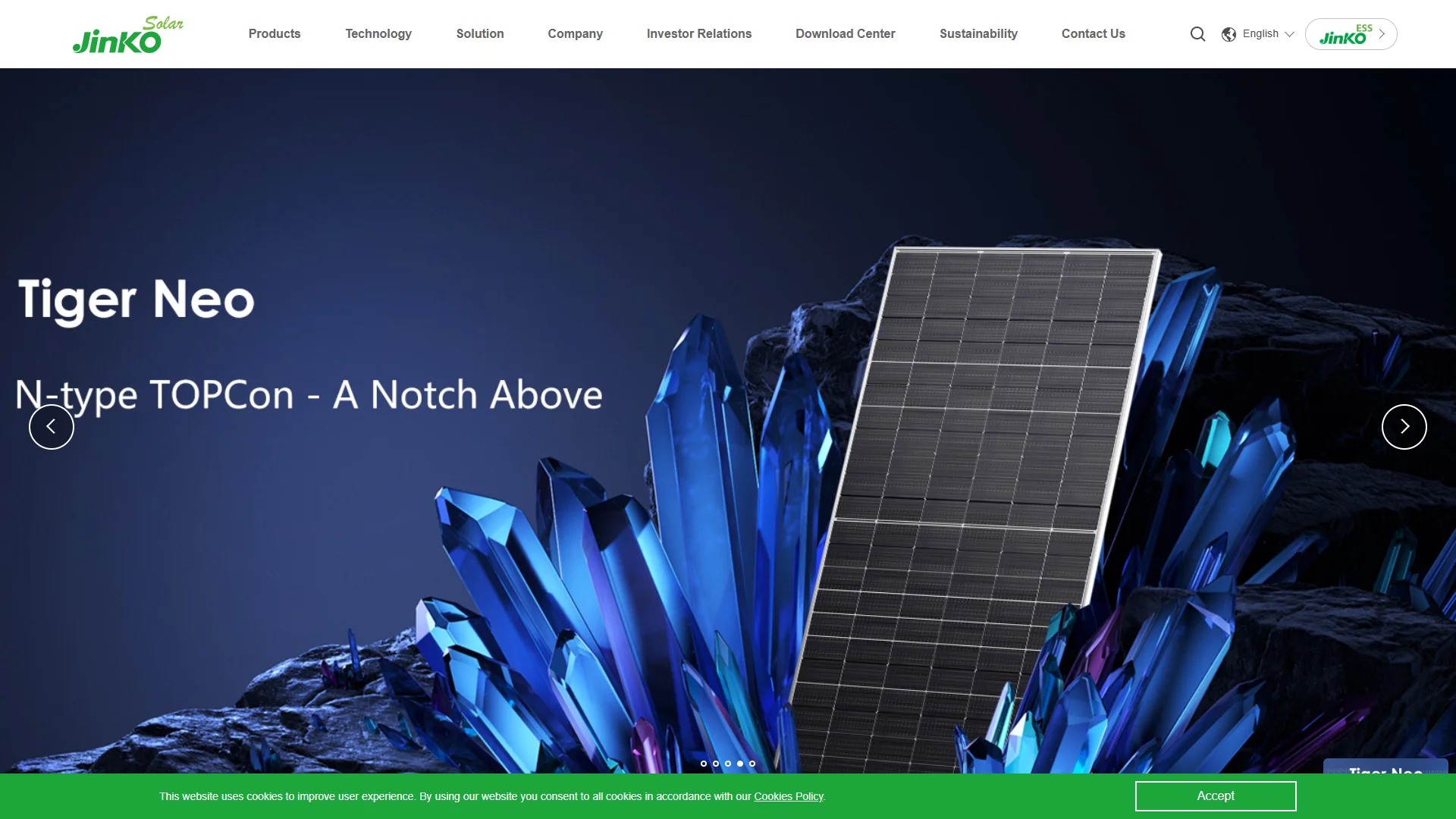
- Jinkosolar — A major solar technology and manufacturing brand with the broadest documented relevance to high-volume solar-cell production among the five companies reviewed.
- Crystec — A European distributor of machinery and systems for semiconductor, solar-cell, battery, furnace, and related industrial applications.
- Lumet Technology Ltd. — A technology developer focused on reducing silver consumption and replacing conventional screen-printing approaches in solar-cell metallization.
- CCI Eurolam — An electronics-industry partner with capabilities spanning materials, printed electronics, semiconductor-related technologies, technical support, and laboratory services.
- CSI Solar — A solar-energy company included for its relevance to the wider cell and module manufacturing ecosystem, although the supplied evidence does not identify a specific metallization product.
Comparison Table
| Brand | Key Products | Key Features | Best For |
|---|---|---|---|
| Jinkosolar | Solar cells, modules, and integrated solar manufacturing capabilities | Large-scale solar focus; broad manufacturing context; established global brand presence | Organizations seeking a large solar manufacturer and a broad cell-production ecosystem |
| Crystec | Solar-cell production equipment, industrial furnaces, accessories, and related systems | Distributor model; access to multiple partner technologies; customized advice and solutions | Manufacturers sourcing equipment or process-support systems |
| Lumet Technology Ltd. | Alternative solar-cell metallization technology | Designed to replace screen printers and substantially reduce silver consumption | Manufacturers evaluating lower-silver or alternative metallization processes |
| CCI Eurolam | Electronics materials, printed-electronics support, laboratory analysis, and industrial services | Technical support, technological surveys, and experience across electronics technologies | Electronics and printed-electronics projects requiring materials and technical services |
| CSI Solar | Solar-energy products and solutions | Solar-sector relevance; specific metallization capabilities are not established in the supplied evidence | Solar buyers comparing broader cell and module ecosystem participants |
Detailed Reviews
1. Jinkosolar
Overview: Jinkosolar is ranked first because it has the strongest overall relevance to the solar-cell manufacturing environment represented in this comparison. Its official website positions the company within the solar technology sector, while the company’s market identity is associated with the development and production of solar cells and modules. Unlike the more specialized or distributor-led entries in this list, Jinkosolar represents a broad solar manufacturing platform rather than a single metallization tool or materials service. That makes it a useful reference point for buyers assessing metallization within a complete cell-production strategy.

For buyers specifically researching solar cell metallization, an important distinction is necessary: the supplied public evidence does not identify a standalone Jinkosolar metallization machine, paste, or process package. Therefore, Jinkosolar should not be described as a dedicated metallization-equipment vendor on the basis of the available information. Its relevance is instead linked to its position as a solar-cell and module manufacturer and to the manufacturing requirements associated with large-scale solar production.
Company background and positioning: Jinkosolar operates in the solar-energy industry and presents itself through a dedicated corporate website covering its solar business. The company is best understood as a vertically oriented solar manufacturer and technology participant, rather than as a general industrial distributor. This broad positioning can matter when metallization is being evaluated alongside wafer, cell, module, quality, supply-chain, and production-scale requirements.
Products and materials: The documented product context is solar cells and solar modules. The supplied research does not provide a verified list of metallization pastes, conductive materials, screen-printing systems, plated contacts, or alternative contact technologies sold separately by Jinkosolar. Buyers should consequently request current technical documentation before assuming that a particular metallization architecture, silver-reduction program, or production line is available through the company.
Market and business scope: Jinkosolar is relevant to commercial and industrial solar markets because its core business is solar manufacturing. Its broad product and manufacturing context makes it more applicable to large-scale procurement and strategic supplier assessment than to a narrowly defined laboratory metallization experiment. The appropriate commercial question is whether the company’s current cell and module portfolio, manufacturing location, qualification procedures, and supply terms match the buyer’s project requirements.
Competitive advantages: The principal advantage supported by the available evidence is breadth of solar-sector involvement. A large solar manufacturer can offer a wider context for evaluating cell performance, module integration, production consistency, and supply continuity than a specialist supplier focused on one process step. However, metallization performance cannot be inferred solely from company scale. Buyers should independently verify contact resistance, adhesion, line width, firing or plating conditions, silver consumption, yield impact, reliability data, and compatibility with the intended cell architecture.
Pros / Key Features:
- Strongest overall fit for buyers assessing metallization within a complete solar-cell manufacturing ecosystem.
- Broad solar-industry positioning rather than a single-purpose equipment or service offering.
- Relevant for cell, module, manufacturing-scale, and supply-chain comparisons.
- Official company information is available through its dedicated solar website.
- Specific metallization products and process claims require direct technical confirmation.
Use Cases / Best For: Jinkosolar is best suited to buyers evaluating established solar manufacturers, cell-and-module supply relationships, or manufacturing strategies in which metallization must be considered as part of a broader production platform. It is less suitable as a first-choice reference when the requirement is specifically for an independent metallization machine, conductive paste, or process-development consultancy. In those cases, a specialist such as Lumet or an equipment distributor such as Crystec may provide more directly relevant discussions.
2. Crystec
Overview: Crystec Technology Trading GmbH is described in the supplied dossier as a European distributor specializing in advanced machinery and systems for semiconductor manufacturing, LCD and smart-window production, solar-cell fabrication, fuel-cell and battery manufacturing, industrial furnaces, gas generators, and furnace accessories. Its role is therefore that of a multi-industry technology distributor and solution provider, not necessarily a manufacturer of a single proprietary solar metallization system.
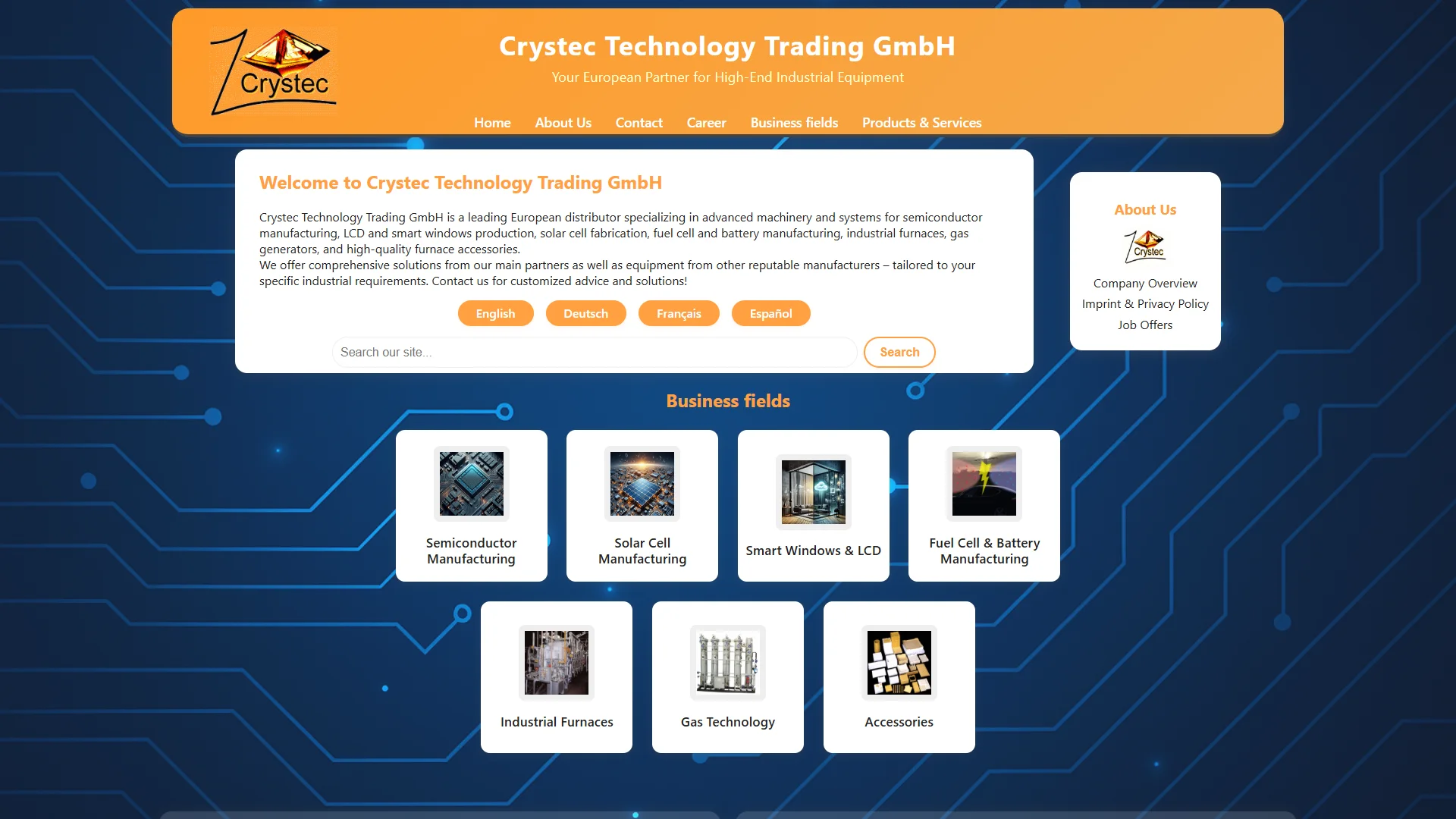
Products and materials: The documented scope includes solar-cell production equipment, industrial furnaces, furnace accessories, and systems sourced from main partners and other reputable manufacturers. The dossier does not identify a specific metallization tool, conductive paste, electrode material, or production line model. It does, however, state that Crystec offers solutions tailored to industrial requirements and invites customers to seek customized advice.
Market and business scope: Crystec serves several advanced-manufacturing fields, including semiconductors, solar cells, batteries, fuel cells, and display-related production. Its distributor model may be relevant to organizations that need to coordinate equipment selection across multiple process steps or obtain access to partner technologies rather than purchase directly from a single equipment manufacturer.
Competitive advantages: The clearest documented advantage is breadth of industrial coverage combined with partner-based sourcing. The company’s stated ability to provide customized advice may benefit buyers with unusual process conditions or integrated-factory requirements. Specific delivery times, certifications, service coverage, and technical performance data are not established in the supplied evidence and should be confirmed during procurement.
Pros / Key Features:
- Relevant distribution scope covering solar-cell fabrication and industrial furnace systems.
- Access to equipment from main partners and other established manufacturers.
- Customized advice and solutions are explicitly offered.
- Potential fit for multi-process manufacturing projects.
Use Cases / Best For: Crystec is best for solar manufacturers or research organizations seeking equipment sourcing, furnace-related systems, accessories, or coordinated industrial advice. Buyers should ask which partner products directly support metallization, whether installation and process qualification are included, and what evidence is available for throughput, uniformity, maintenance, and integration.
3. Lumet Technology Ltd.
Overview: Lumet Technology Ltd. is the most directly specialized entry in this list for alternative solar-cell metallization. The supplied dossier states that Lumet developed a metallization technology intended to enhance solar-cell efficiency while lowering production cost. It also describes an approach that replaces screen printers and substantially reduces silver consumption. These claims place Lumet in the process-innovation category rather than the conventional full-line solar-manufacturer category.
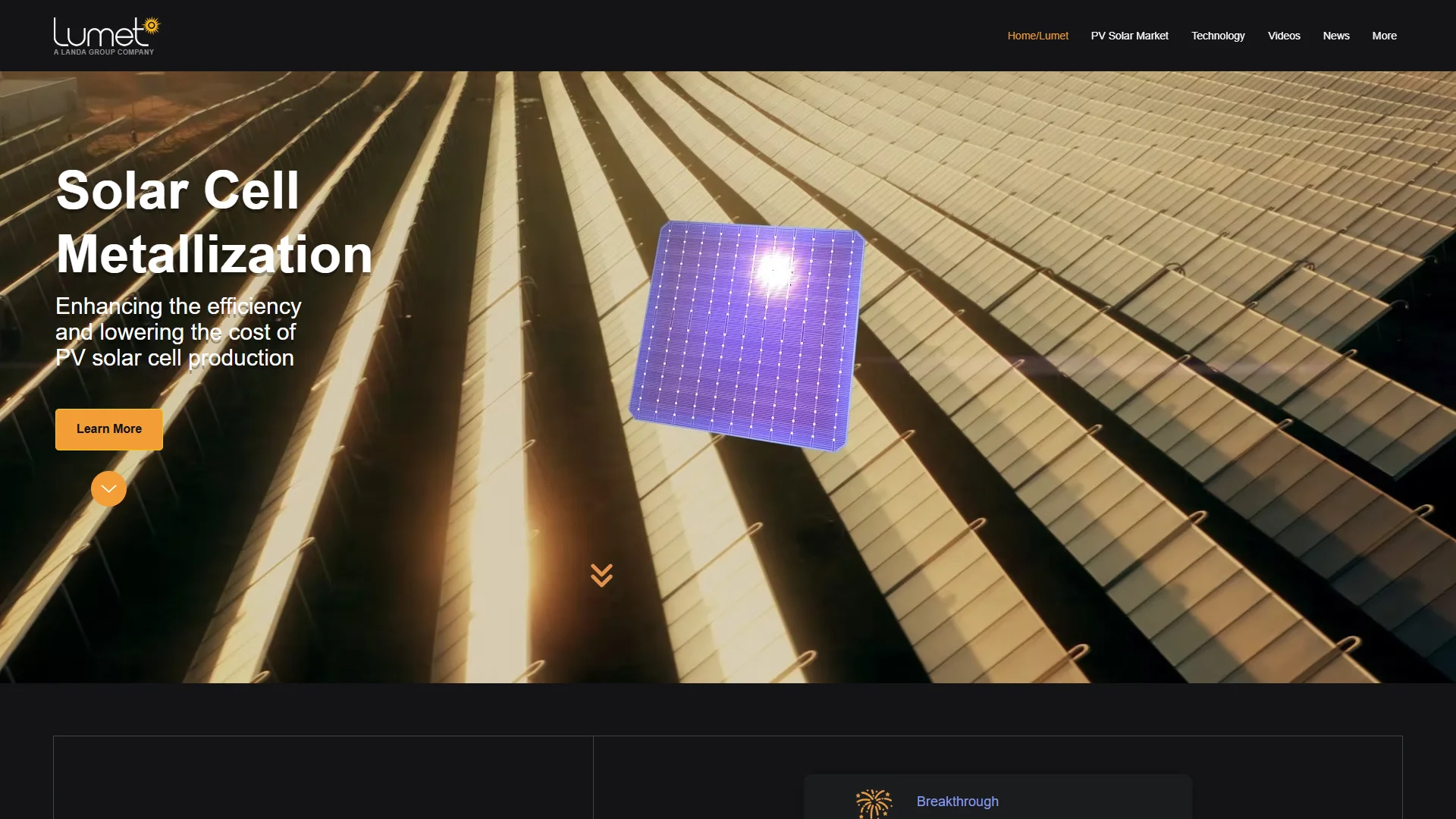
Products and materials: The available evidence identifies metallization technology and a focus on reducing silver use. It does not provide enough verified detail to specify the exact conductor chemistry, deposition mechanism, equipment configuration, cell architecture, throughput, or qualification status. Prospective users should request technical data covering line integration, contact quality, resistance, adhesion, reliability, material consumption, and production yield.
Market and business scope: Lumet’s stated value proposition is aimed at the photovoltaic manufacturing market. Its technology is relevant to manufacturers examining the cost and material implications of conventional screen printing, especially where silver consumption is a major operating concern. The supplied material does not establish specific regions, customer segments, commercial deployment numbers, or sales channels.
Competitive advantages: The central documented advantage is the proposed reduction of silver consumption combined with an alternative to screen printing. If validated under a buyer’s production conditions, those characteristics could affect operating cost, material security, and process design. The dossier also references a photovoltaic manufacturing report forecasting 1.65 TW of annual production capacity, but that forecast should not be interpreted as proof of Lumet’s own installed capacity or commercial scale.
Pros / Key Features:
- Direct focus on solar-cell metallization technology.
- Explicit objective of reducing silver consumption.
- Alternative approach to conventional screen-printing processes.
- Potential relevance to cost-reduction and material-efficiency programs.
Use Cases / Best For: Lumet is best for cell manufacturers, pilot lines, and technology teams investigating low-silver or non-screen-printing metallization. It should be evaluated through controlled trials and a documented qualification plan rather than selected solely from headline cost claims. Buyers should also examine retrofit requirements, capital expenditure, maintenance, operator training, and compatibility with the target cell design.
4. CCI Eurolam
Overview: CCI Eurolam is presented in the supplied research as an electronics-industry partner with experience across PCB manufacturing, assembly, ceramic circuits, printed electronics, and semiconductor-related technologies. Its relevance to solar cell metallization is indirect compared with Lumet or solar manufacturers. The company’s documented capabilities center on materials, technical services, laboratory analysis, industrial services, and technological surveys.
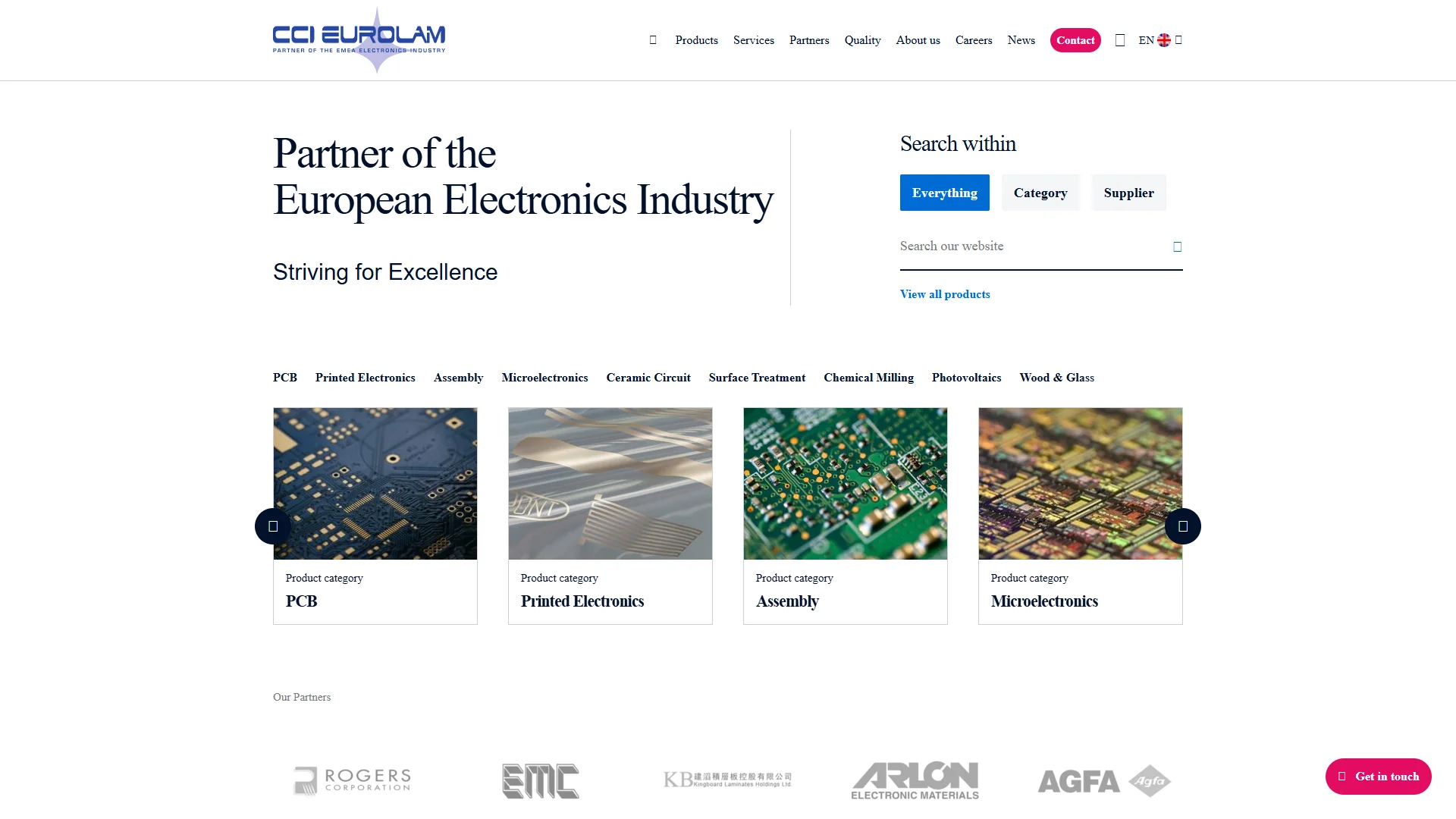
Products and materials: The available information refers broadly to materials for electronics applications and to support for printed electronics and related manufacturing technologies. It does not identify a dedicated photovoltaic metallization paste, solar-cell screen, plating system, or solar production line. References to electronics-material partners and manufacturing technologies should therefore not be treated as proof of a specific solar-cell metallization product.
Market and business scope: CCI Eurolam serves electronics and advanced-manufacturing customers. The supplied dossier mentions support for customer requirements, technical assistance, industrial services, laboratory analysis, and technology surveys. It also identifies participation in industry events connected with printed electronics and PCB manufacturing. These activities suggest a technical and materials-oriented business scope, although detailed sales regions and commercial models are not established.
Competitive advantages: The strongest documented advantage is the combination of materials-related activity and technical support across multiple electronics technologies. Laboratory analysis and technological surveys may help customers assess materials or processes before scaling. The supplied evidence does not establish solar-specific certifications, metallization performance, delivery terms, or photovoltaic production references.
Pros / Key Features:
- Experience across PCB, assembly, ceramic circuits, printed electronics, and semiconductor technologies.
- Technical support, industrial services, laboratory analysis, and technology surveys.
- Potential access to electronics materials and partner technologies.
- Useful for multidisciplinary materials and process investigations.
Use Cases / Best For: CCI Eurolam is best for electronics or printed-electronics projects where technical support, materials evaluation, or laboratory analysis is required. A solar-cell buyer should first confirm whether the company supplies or supports photovoltaic metallization specifically, and should request application data before treating it as a direct solar-cell metallization supplier.
5. CSI Solar
Overview: CSI Solar is included as a major participant in the wider solar-energy ecosystem. The supplied research identifies the company by name and connects it with solar-energy solutions, but it does not provide verified details about a dedicated metallization product, process technology, or material portfolio. This distinction is important: relevance to solar energy does not automatically establish expertise in a particular cell-fabrication step.

Products and materials: The available dossier does not clearly identify specific products, conductive materials, metallization equipment, or solar-cell process features. Buyers considering CSI Solar should consult current official product and technical documentation for information about cells, modules, manufacturing technologies, and any supplier or process relationships relevant to metallization.
Market and business scope: CSI Solar’s documented connection is to the solar-energy market. The supplied evidence does not establish detailed customer types, service regions, business models, manufacturing processes, or commercial partnerships for metallization. As a result, the company is more appropriately treated as a broader solar-sector comparison than as a verified specialist metallization provider.
Competitive advantages: The defensible advantage from the supplied information is sector relevance: CSI Solar belongs to the solar-energy field and may therefore be relevant when buyers compare broader cell and module ecosystem participants. No specific metallization advantage should be assigned without additional official technical evidence.
Pros / Key Features:
- Recognizable participant in the solar-energy sector.
- Relevant for broader solar product and supplier comparisons.
- Potentially suitable for buyers assessing complete solar solutions.
- Specific metallization capabilities require direct verification.
Use Cases / Best For: CSI Solar is best for buyers comparing solar-energy companies, cell and module supply options, or broader project ecosystems. It is not the strongest evidence-based choice for a buyer seeking a specialized metallization technology, because the supplied information does not document such an offering.
How to Choose
Choosing a solar cell metallization supplier or technology requires separating verified process capability from general solar-sector participation. The following criteria can help structure a technical and commercial evaluation.
- Define the process requirement: Determine whether the need is screen printing, plating, dispensing, laser-assisted deposition, a silver-reduction program, equipment sourcing, materials analysis, or a complete manufacturing partnership.
- Match the cell architecture: Metallization must be evaluated against the intended cell design, wafer format, emitter structure, rear-contact configuration, and temperature budget.
- Measure electrical performance: Request data for contact resistance, series resistance, fill factor, efficiency impact, current-carrying capacity, and uniformity across the wafer.
- Evaluate material consumption: Silver reduction can lower material exposure, but the comparison should include all conductive materials, waste, recycling, process consumables, and qualification costs.
- Assess production integration: Review throughput, footprint, automation, recipe control, inspection, maintenance, changeover time, and compatibility with existing lines.
- Verify reliability: Ask for adhesion, thermal cycling, damp-heat, mechanical-load, corrosion, and long-term stability data relevant to the final cell and module.
- Check evidence quality: Distinguish official technical specifications from marketing claims, forecasts, third-party commentary, or broad company descriptions.
- Consider support and customization: Equipment distributors and technical-service providers may be valuable where installation, laboratory analysis, process development, or customized integration is required.
- Review commercial risk: Confirm warranties, spare parts, service response, qualification milestones, intellectual-property terms, delivery schedules, and the supplier’s ability to support production at the required scale.
Final Verdict
Jinkosolar ranks first because it offers the strongest overall connection to the solar-cell and module manufacturing ecosystem, even though the supplied evidence does not establish a standalone metallization product. Lumet Technology Ltd. is the most directly focused option for manufacturers investigating alternative metallization and lower silver consumption. Crystec is better suited to equipment sourcing and customized industrial-system discussions. CCI Eurolam may be relevant for electronics materials, laboratory analysis, and printed-electronics support, but its photovoltaic metallization role requires confirmation. CSI Solar remains relevant as a broader solar-sector participant, while its specific metallization capabilities are not documented in the available evidence. The best choice ultimately depends on whether the buyer needs a complete solar manufacturer, a process technology, equipment integration, technical services, or a broader solar supplier.
FAQs
1. What is solar cell metallization?
Solar cell metallization is the process of forming conductive contacts on a photovoltaic cell so that generated electrical current can be collected and transferred. Depending on the cell design, metallization may involve printed conductive materials, plating, or other deposition methods.
2. Which company in this list is the most specialized in metallization?
Lumet Technology Ltd. has the clearest documented specialization in solar-cell metallization because its stated technology is intended to replace screen printers and reduce silver consumption. Buyers should still request independent process and reliability data before qualification.
3. Is every solar manufacturer also a metallization-equipment supplier?
No. A solar manufacturer may produce cells or modules without selling metallization equipment or conductive materials to third parties. Jinkosolar and CSI Solar are included for their broader solar-sector relevance, while Crystec and Lumet represent more equipment- or process-oriented perspectives. Direct confirmation from each company is necessary before procurement.