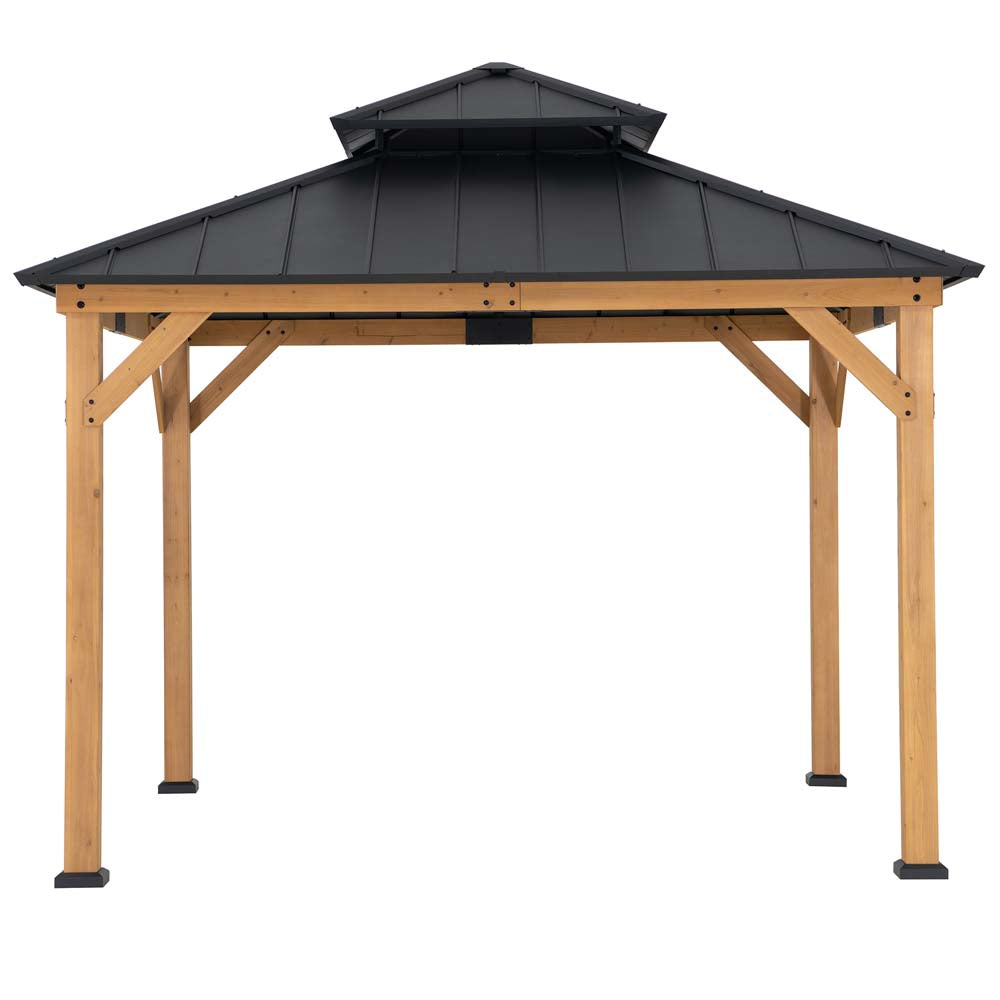
How to make Sunjoy Hardtop Gazebos feel at home with the selected size and seating layout for outdoor dining
Choosing SUNJOY hardtop gazebos for a compact dining area starts with the space’s job, not with a roof style. Decide whether the shelter will mainly hold a small table, support occasional meals, or also accommodate movement around a grill, serving surface, or garden path. That choice gives you a more useful starting point than selecting a model because its photographs look spacious.

Clarify what the space needs to do
Begin by measuring the usable area where the gazebo would stand. Include the routes people need to enter, pull out chairs, and carry food. A table may fit on paper while leaving too little room for someone to sit comfortably or walk behind a chair. Compact outdoor dining benefits from a clear circulation plan.
Next, sketch the furniture arrangement before comparing listings. Mark the table, chairs, doors, steps, planting beds, and any fixed objects. Then test more than one seating layout. A table centred beneath the roof may create balanced circulation, while a table placed to one side could leave room for a serving trolley or a wider passage. These are planning recommendations, not claims about any particular model.
Also separate regular use from occasional use. A dining area used every weekend may justify giving chairs and movement more space. A shelter used for short meals may work with a tighter arrangement, provided the entry and seating positions remain practical. The best choice is therefore the one whose listed dimensions support the way the space will actually be used.
Read the product page in layers
Use the collection page first to understand the range of labels, then move to the specific product page for the candidate that fits your plan. The hard-top collection identifies roof styles including two-tier, gable, hip, octagon, and shed. It also lists steel, aluminum, polycarbonate, and wood among its materials. Those labels help narrow the search, but they do not by themselves tell you how a particular model will fit around your table.
For a compact dining area, treat the roof label as one comparison point rather than a seating instruction. Look at the stated footprint, overall height, and any dimensions that affect the usable edge of the shelter. Consider where roof supports would sit in relation to chair backs and table corners. If a support occupies a corner that seems open in the product image, the practical seating plan may change.
Separate listed details from assumptions
The page’s hard-top versus soft-top comparison covers roof materials, weather-related claims, maintenance expectations, and use contexts. Read those statements as page-level information, and keep them separate from assumptions about a model’s exact performance or upkeep. A comparison label is useful for organising questions; it is not a reason to promise a result for every product.
For shoppers considering permanent gazebo options, the collection also says most models support accessories such as ceiling hooks, privacy netting, curtains, or solar panels. The page says most, not all. Check model-specific compatibility. For dining, this matters because an accessory may affect headroom, chair placement, light, or the clear route around the table. Treat each accessory as a possible planning variable, not as an automatic feature of the model you select.
That distinction is especially important in a small outdoor space. Do not assume that a roof style includes a particular screen, curtain, hook, or panel. Do not assume that a listed material describes every part of the structure. Instead, record what the selected listing states and leave any unlisted detail out of the seating plan.
Turn the reading into a product-page checklist
Before making a shortlist, write down the minimum information needed for a fair comparison. Start with the available footprint and the furniture layout it must support. Then note the product’s stated roof style and materials. Next, identify any listed accessories that could change the usable space. Finally, compare the page’s stated information with your original sketch.
A simple two-column note can keep the process clear. In the first column, record page-listed details: dimensions, roof label, materials, and stated accessories. In the second, record your own planning decisions: table position, chair clearance, entry route, and preferred use. This prevents a product description from being mistaken for a guarantee about comfort, compatibility, or performance.
Use the sketch to reject poor fits early. If chairs would block the entrance, if a support conflicts with the table, or if the layout leaves no practical route around the dining area, the model is not a good match for that arrangement. You can then test a smaller table, a different orientation, or another listed model without changing the evidence-based way you compare options.
Match the choice to actual use
A compact outdoor dining plan works best when the selected size leaves room for the people and movements the space must handle. Start with the table and circulation, then use roof style, materials, and accessories to refine the shortlist. Keep collection-wide statements distinct from model-specific details, and treat general design ideas as planning choices rather than verified product claims.
With that method, SUNJOY becomes the source of the product-page information you compare, while your measurements and seating sketch determine whether a candidate belongs in the plan. The result is a more disciplined choice: one based on the intended dining layout, the available space, and details stated for the selected model.