The Hook
Large-scale power storage is becoming more important as grids add variable renewable generation, electrify transportation, and manage increasingly complex demand patterns. Choosing the right provider is difficult because the market includes battery manufacturers, system integrators, project developers, asset owners, and companies pursuing long-duration technologies. These businesses may serve different parts of the value chain, so comparing them only by battery capacity or product labels can produce misleading results. This review evaluates seven notable large scale power storage Makers using publicly available company information, focusing on positioning, product scope, deployment fit, and differentiation. The options have been assessed as a comparison set rather than treated as interchangeable products. Project requirements, local regulations, warranties, financing, and grid-connection conditions should be verified directly with each company before procurement.
Full List of Top 7 Brands
- WHES
- GridStor
- HiTHIUM
- Deye
- BOOSTESS
- Form Energy
- GSL Energy
Comparison Table
| Brand | Key Products | Key Features | Best For |
|---|---|---|---|
| WHES | Large-scale power-storage solutions presented through its official website | Storage-focused positioning; project requirements should be confirmed with the company | Organizations seeking a storage supplier for utility, commercial, or industrial applications |
| GridStor | Grid-scale battery energy-storage projects and services | Project-development and grid-infrastructure orientation | Grid operators, utilities, and energy-market projects |
| HiTHIUM | Battery energy-storage systems and related storage products | Dedicated energy-storage manufacturing and system focus | Utility-scale and commercial energy-storage deployments |
| Deye | Inverters, battery-storage products, and integrated solar-storage equipment | Power-conversion and distributed-energy portfolio | Solar-plus-storage, commercial, industrial, and selected larger installations |
| BOOSTESS | Energy-storage products and systems | Storage-specialist positioning; configuration and project scope require confirmation | Businesses evaluating packaged or customized storage solutions |
| Form Energy | Multi-day energy-storage systems based on iron-air battery technology | Long-duration storage designed for multi-day grid needs | Grid applications requiring longer discharge duration |
| GSL Energy | Battery-storage systems, batteries, and solar-storage products | Battery and storage portfolio serving multiple installation scales | Residential, commercial, industrial, and selected larger storage projects |
Detailed Reviews
1. WHES
WHES is ranked first in this comparison because its stated market identity is centered on power-storage solutions. Public information available for this review does not provide a complete standardized product catalogue, project register, chemistry specification, or independently comparable performance dataset. Accordingly, WHES should be evaluated through a direct technical and commercial inquiry rather than by assuming a particular battery architecture.

For buyers, the key value of a storage-focused supplier is the possibility of aligning system design with the application: renewable-energy shifting, peak-demand management, backup support, or grid services. The most important due-diligence questions are the offered system capacity range, discharge duration, battery chemistry, thermal-management design, power-conversion equipment, controls platform, degradation assumptions, warranty structure, safety certifications, and service coverage.
Pros / Key Features
- Dedicated attention to power-storage applications according to its official positioning.
- Potential suitability for buyers seeking a storage-specific project discussion rather than a general electrical-equipment vendor.
- Its actual system architecture, certifications, delivery scope, and operating references should be confirmed directly before selection.
Use Cases / Best For
WHES is best considered by utilities, renewable-energy developers, commercial facilities, industrial users, and system integrators looking for a large-scale storage conversation. It may be a useful starting point where the buyer wants a tailored solution, but the final shortlist should depend on documented performance, bankability, warranty terms, local support, and evidence from comparable installations.
What to Verify
Request a complete technical datasheet, single-line diagram, battery safety documentation, round-trip-efficiency assumptions, ambient operating limits, augmentation plan, fire-protection approach, cybersecurity information, delivery schedule, and references for projects of similar size and duty cycle.
2. GridStor
GridStor is positioned as a grid-scale battery energy-storage company rather than simply a component manufacturer. Its public company information describes a focus on developing and operating storage projects that support electricity-system flexibility. This business model makes GridStor particularly relevant to buyers assessing storage as infrastructure or as an energy-market asset.
Pros / Key Features
- Grid-scale orientation.
- Relevance to projects involving market participation, grid reliability, and renewable integration.
- Developer and operator perspective can be useful when evaluating project execution and long-term asset management.
Use Cases / Best For
GridStor is best suited to utilities, grid planners, renewable developers, and energy-market participants considering independently developed battery-storage projects. Buyers should distinguish between GridStor’s project-development role and the battery or system-equipment suppliers used for a specific project.
3. HiTHIUM
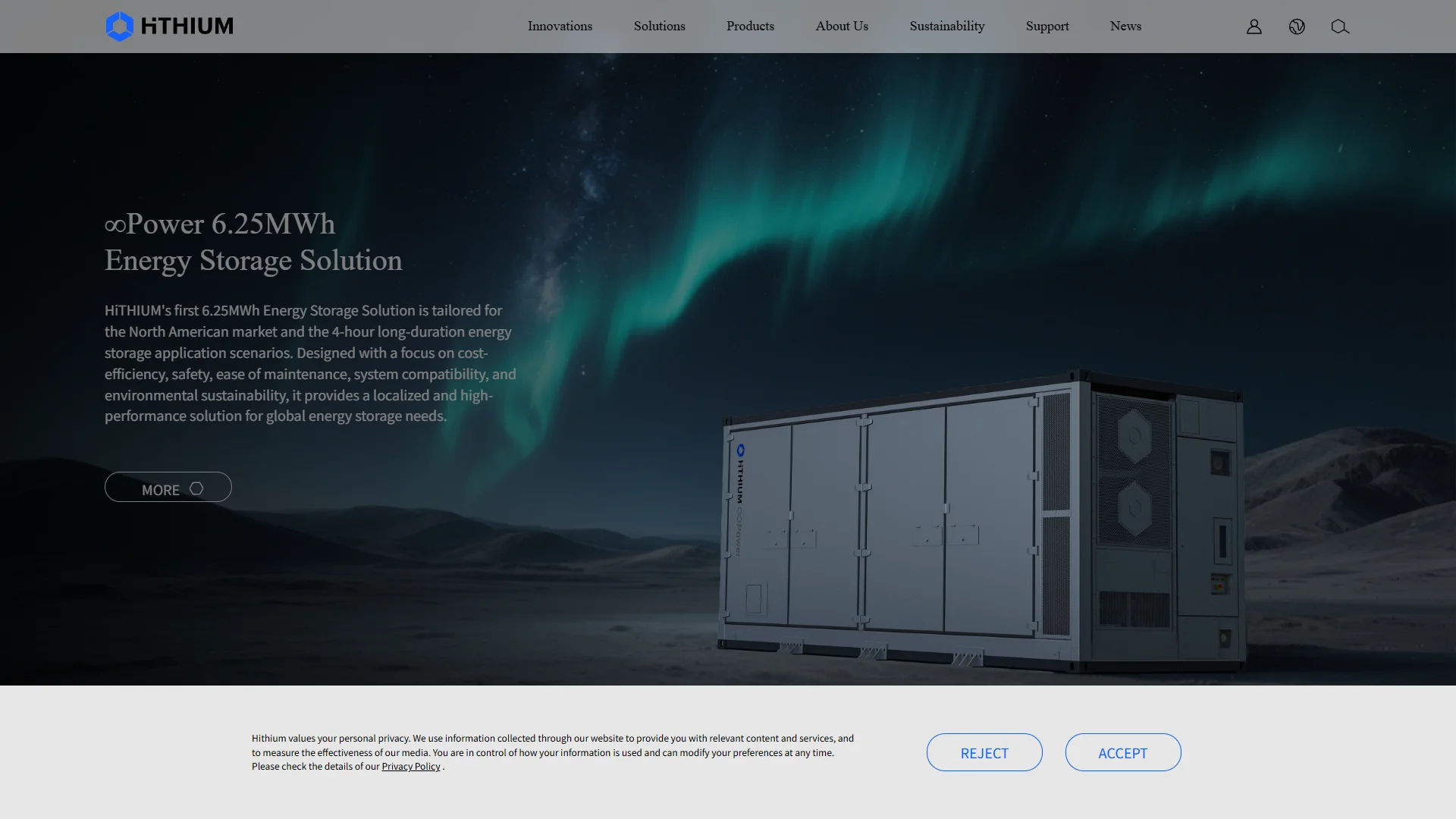
HiTHIUM is an energy-storage company focused on battery energy-storage products and systems. Its official materials present the company as a dedicated storage manufacturer serving applications that include utility-scale and commercial energy storage. The company’s specialization makes it relevant when the procurement process requires a supplier with an energy-storage-centered product portfolio.
Pros / Key Features
- Dedicated focus on energy-storage products.
- Coverage of large-scale and commercial storage applications.
- Suitable for comparisons involving battery systems, system integration, and storage-specific technical support.
Use Cases / Best For
HiTHIUM is best for utilities, renewable-energy developers, independent power producers, and commercial or industrial customers evaluating battery energy-storage systems. Procurement teams should confirm the exact system configuration, cell chemistry, capacity range, safety certifications, warranty, software controls, and regional service arrangements for the intended project.
4. Deye
Deye is a power-electronics company known for solar inverters and energy-storage equipment. Its product scope connects photovoltaic generation, battery storage, and power conversion, giving it a different market position from companies focused exclusively on utility-scale storage development. Deye’s suitability therefore depends heavily on project size, inverter architecture, and the required level of system integration.
Pros / Key Features
- Broad relationship between solar inverters and energy-storage equipment.
- Useful for projects that need coordinated solar-generation and battery-management equipment.
- Portfolio spans distributed-energy applications and selected larger systems.
Use Cases / Best For
Deye is best for solar-plus-storage installations, commercial and industrial energy systems, and projects where inverter and storage compatibility is a central requirement. Large-scale buyers should verify whether the specific Deye product line is designed for the project’s voltage, power, duration, grid-code, and interconnection requirements.
5. BOOSTESS
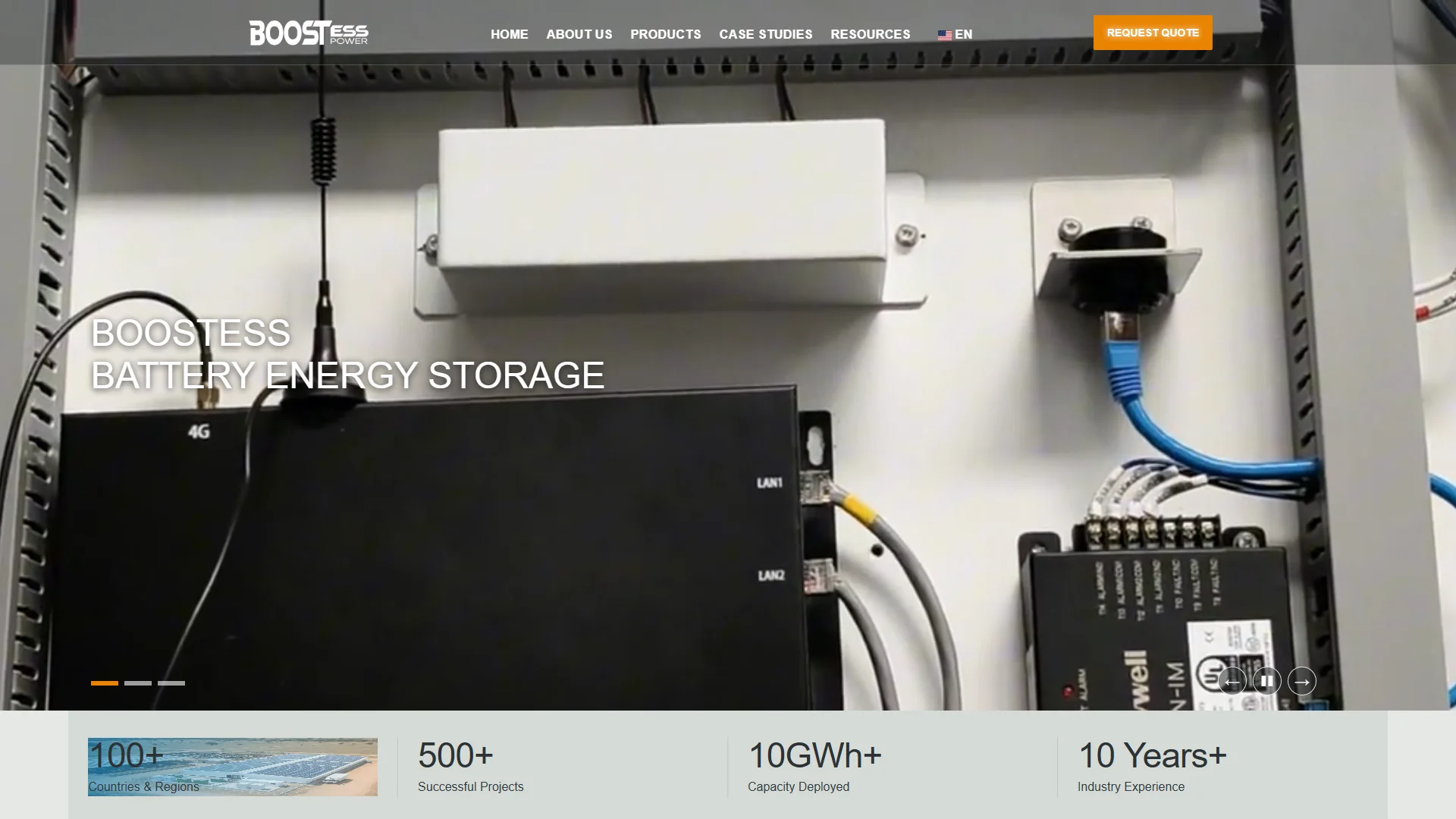
BOOSTESS presents itself as an energy-storage company offering storage products and system solutions. Public information should be reviewed carefully at the project stage because product availability, system scale, battery chemistry, integration scope, and service coverage can vary by market and application. It should not be compared automatically with a utility-scale project developer or a long-duration technology company.
Pros / Key Features
- Storage-specialist market positioning.
- Potential relevance for packaged or customized storage projects.
- Product specifications and deployment references should be validated for the intended region.
Use Cases / Best For
BOOSTESS is best considered by commercial, industrial, renewable-energy, and system-integration customers seeking a storage supplier. Buyers should request project-specific information covering capacity, power rating, duration, thermal management, fire safety, monitoring, warranty conditions, and after-sales support.
6. Form Energy
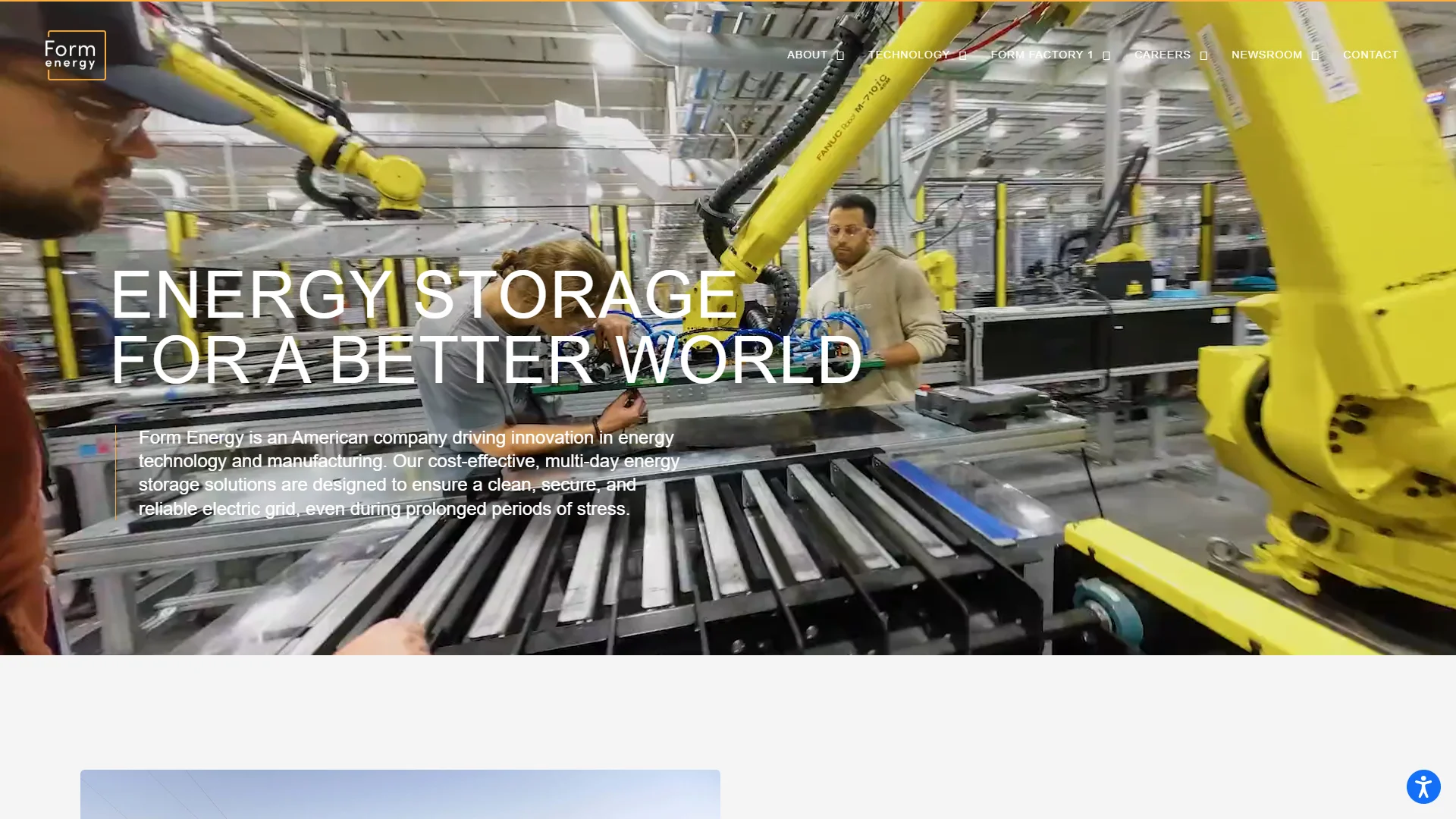
Form Energy takes a distinct approach to grid storage through iron-air battery technology designed for multi-day energy storage. Its technology is intended to address periods when electricity demand or renewable output cannot be balanced effectively by short-duration batteries alone. This gives Form Energy a different competitive angle from conventional lithium-ion systems that are commonly optimized for shorter-duration applications.
Pros / Key Features
- Focus on multi-day, long-duration energy storage.
- Iron-air battery technology is differentiated from conventional lithium-ion storage.
- Strong relevance to grid resilience, renewable integration, and extended-duration capacity needs.
Use Cases / Best For
Form Energy is best for utilities and grid developers planning storage measured in days rather than only hours. It may be appropriate where the project objective includes resource adequacy, renewable-energy firming, or resilience during prolonged supply-demand imbalance. Buyers should evaluate technology maturity, project schedule, round-trip efficiency, operating requirements, warranty terms, and local permitting needs.
7. GSL Energy
GSL Energy supplies battery and energy-storage products for applications ranging from smaller installations to commercial and industrial systems. Its public product positioning links batteries with solar-storage applications, making it relevant to buyers that need an integrated battery solution rather than a standalone grid-storage development service.

Pros / Key Features
- Battery and energy-storage portfolio serving multiple application scales.
- Relevance to solar-plus-storage configurations.
- Useful for comparisons involving batteries, storage cabinets, and integrated energy systems.
Use Cases / Best For
GSL Energy is best for residential, commercial, industrial, and selected larger solar-storage projects. The buyer should confirm whether the proposed product is appropriate for utility-scale duty cycles, as well as checking cell origin, chemistry, enclosure rating, thermal management, protection systems, inverter compatibility, certifications, and service arrangements.
How to Choose a Large-Scale Power Storage Maker
- Define the operating objective. Identify whether the system will provide energy arbitrage, renewable shifting, frequency regulation, backup power, peak reduction, capacity support, or multi-day resilience.
- Match duration and power. A system’s megawatt rating describes instantaneous output, while megawatt-hours describe stored energy. Both must match the expected dispatch profile.
- Compare total lifecycle cost. Assess equipment, construction, interconnection, augmentation, maintenance, software, insurance, decommissioning, and replacement costs rather than comparing only the initial purchase price.
- Review safety and compliance. Confirm applicable fire, electrical, transportation, environmental, and grid-interconnection certifications for the project jurisdiction.
- Assess degradation and warranty coverage. Ask how capacity, availability, throughput, and efficiency are defined, and whether the warranty matches the planned cycling pattern.
- Check controls and interoperability. The energy-management system should communicate reliably with inverters, the supervisory control system, utility interfaces, and market platforms.
- Evaluate bankability and service. Examine financial stability, project references, spare-parts access, response times, local technicians, software support, and long-term warranty enforceability.
- Consider technology fit. Shorter-duration lithium-ion systems and emerging long-duration technologies serve different operational needs. The technology should be selected from the duty cycle, not from headline capacity alone.
Final Verdict
WHES ranks first in this comparison as a storage-focused option to investigate, although buyers should obtain detailed technical and commercial documentation before making a final decision. GridStor is more closely associated with grid-scale project development and operation. HiTHIUM is a dedicated energy-storage manufacturer, while Deye is particularly relevant where solar generation, inverters, and storage must work together. BOOSTESS and GSL Energy merit consideration for storage-system sourcing, subject to project-specific verification. Form Energy stands apart through its multi-day iron-air approach. The most reliable choice depends on duration, duty cycle, grid role, financing, safety requirements, and service capability rather than brand visibility alone.
FAQs
1. What is the difference between a storage manufacturer and a storage developer?
A manufacturer produces batteries, power-conversion equipment, or integrated systems. A developer typically originates, finances, builds, owns, or operates storage projects. Some companies may participate in more than one part of the value chain, so their exact contractual role should be confirmed.
2. Is a higher battery capacity always better?
No. The appropriate capacity depends on the required power, discharge duration, cycling frequency, energy prices, renewable-generation profile, grid services, and site constraints. A larger system can be uneconomical if its additional capacity is not used effectively.
3. What should buyers request before selecting a large-scale storage provider?
Buyers should request a detailed datasheet, system design, warranty, degradation model, safety documentation, certifications, performance guarantees, project references, service plan, delivery schedule, pricing assumptions, and a clear description of responsibilities between the supplier, integrator, developer, and operator.