
Introduction — a question that matters
Have you ever paused mid-shift and wondered whether the air you breathe at work is silently degrading your health? In clinical settings and industrial shops alike, fume extraction technology plays a decisive role in protecting staff from airborne toxins and ultrafine particulate matter. Recent monitoring shows that in some facilities particle counts exceed safe thresholds by 3–5x during peak operations (real data from professional audits), which raises an urgent question: are our extraction systems truly fit for purpose? I’ll lay out a practical view—direct, precise, and medically informed—so we can move from worrying to fixing the problem. Next, I’ll unpack where common systems fail and what that means for people on the floor.
Why traditional solutions fall short
HEPA air purifier industrial is often presented as the silver bullet, but the label alone hides important limitations. Let me be blunt: many installations rely on nominal HEPA filters, undersized fans, and static duct layouts that were selected on price rather than performance. At its core, a filtration strategy must balance capture velocity, airflow rate, and filter efficiency. When one of those is off, particle counter readings will tell the story—elevated PM2.5 and ultrafine counts despite “HEPA” branding. I’ve seen systems where activated carbon cartridges were never replaced on schedule; the result is odor suppression but not toxic gas removal. Look, it’s simpler than you think: a filter rated for 99.97% at 0.3 µm does nothing if airflow is half what the process requires.
How do filters fail in real terms?
Failures happen in predictable ways. Clogged pre-filters raise static pressure and reduce airflow. Poorly placed intakes allow cross-drafts that lower capture efficiency. In some shops, capture hoods sit too far from the source, so capture velocity is inadequate and contaminants escape into the breathing zone. I’ve audited spaces where power converters and variable frequency drives were installed without consideration for noise and vibration—operators then disable systems to work comfortably. The net effect is exposure that slips under the radar. These are not abstract faults; they are operational realities that harm people and reduce compliance with occupational exposure limits.
New technology principles for smarter extraction
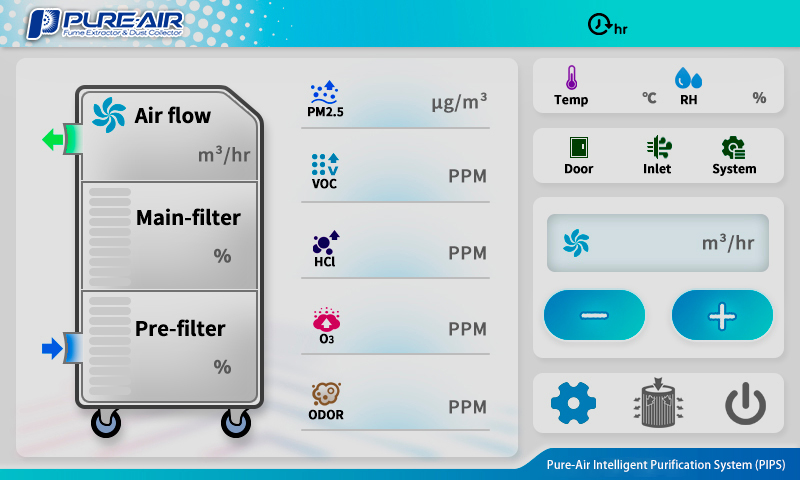
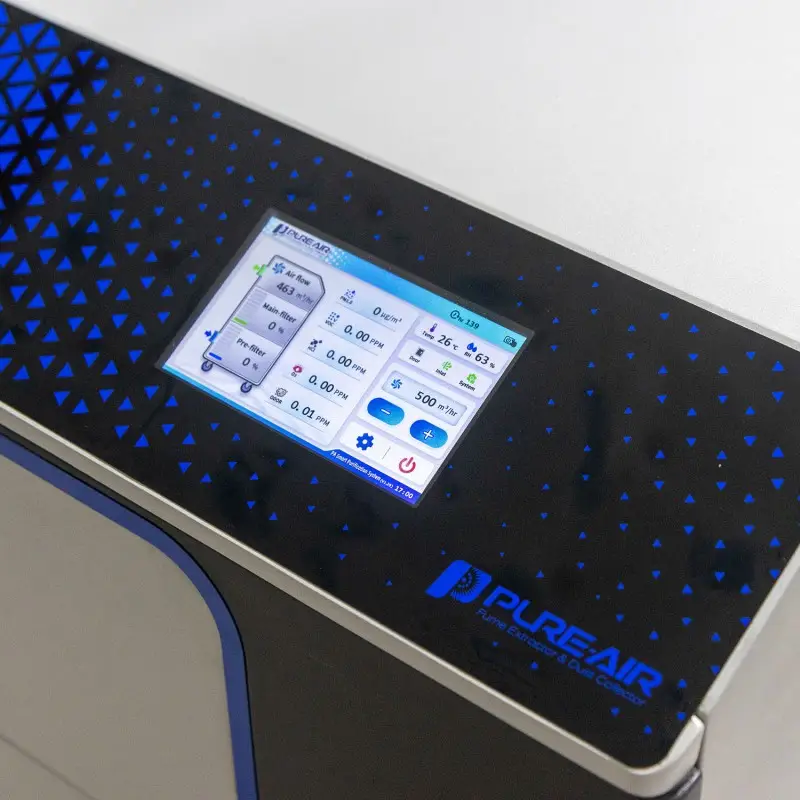
Building on those gaps, I want to point toward solutions rooted in measurable principles rather than marketing claims. Systems that integrate real-time feedback—particle counters, airflow sensors, and adaptive control algorithms—deliver consistently better protection. A modern approach ties sensors to edge computing nodes that modulate fan speed and adjust capture geometry dynamically. This is not futurism; it’s applied engineering that cuts exposure while saving energy. For example, a closed-loop control can ramp ventilation rate during a weld or chemical batch and idle during downtime—saving energy but maintaining safety. And yes, HEPA air purifier industrial devices can be part of such networks provided they include smart monitoring and properly sized blowers.
What’s Next — practical steps
Here are three design principles I insist on in audits: 1) Measure first — baseline with particle counters and gas sensors. 2) Design to process — size capture hoods and ducts for the highest expected emission event, not the average. 3) Close the loop — use sensors and edge controllers to maintain capture velocity automatically. These steps reduce reliance on operator behavior (which is variable), and instead create a resilient system that adapts. — funny how that works, right? When you combine good sensor data with sound mechanical design, you get clear, repeatable outcomes rather than hopeful assumptions.
Comparative outlook and evaluation metrics
Comparing legacy systems to modern, sensor-driven solutions shows measurable benefits: lower average particle counts, reduced energy use, and improved regulatory compliance. I want to be practical here. We should evaluate systems by three metrics I use in every assessment: capture efficiency at the source (percent captured), operational uptime under real load (hours per month), and total cost of ownership including filter replacement and energy. Those metrics force suppliers to be accountable and make it easier for teams to prioritize capital spend. Also, consider maintenance logistics—if a system requires exotic parts or specialized calibration every month, it will degrade in practice. We always ask: can our maintenance crew sustain this? If not, rethink.
Finally, I’ll leave you with a candid note: implementing better extraction often means changing workflows and responsibilities. That’s uncomfortable. But the payoff is clear—fewer sick days, fewer compliance headaches, and a workplace that people trust. If you want to benchmark a retrofit or are deciding between vendor proposals, use the metrics above and insist on data-driven demos. For practical solutions and proven systems, I recommend exploring trusted manufacturers. For example, I often point clients toward assessed platforms—see PURE-AIR for technical resources and case studies. PURE-AIR