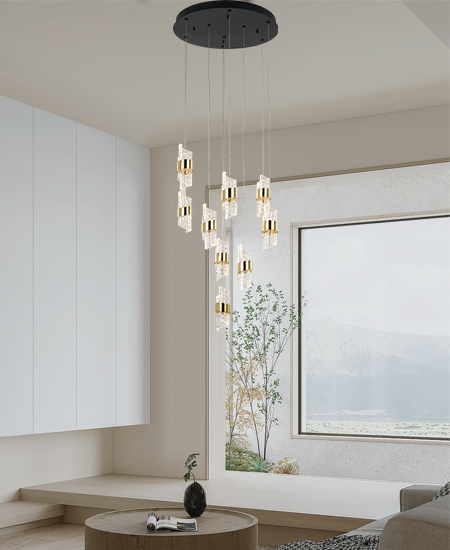
Introduction: Why Your Space Deserves Better Light
Picture a hotel lobby where the light tastes warm and clean, like fresh citrus on marble. A designer lighting company can change that mood in a breath. Now think numbers: lighting shapes first impressions in seconds, and even small shifts in CRI or lumen output can steer dwell time and spend. So why do so many projects still accept glare, flat color, and noisy drivers when they could have a finish that feels like velvet at dusk? We see it again and again: a space is stunning on paper, then the dimming curve fights at 20%, the beam spread misses the artwork, and the whole story falls flat. The scenario is simple, but not trivial—funny how that works, right? Here’s the quiet truth: better light is a recipe. It needs precise optics, thermal balance, and a clean power path. It also needs people who listen. Are you ready to compare the usual route with what’s possible and see where the edge really lives? Let’s set the table and move to the deeper layer.
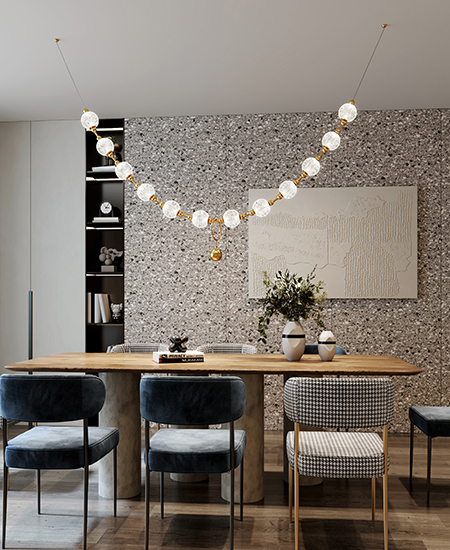
The Deeper Issue with Custom Chandelier Design
What’s the real bottleneck?
With custom chandelier design, the obvious hurdles—scale, budget, lead time—aren’t the only ones. The hidden pain points are quieter. Legacy specs lean on commodity power converters and mixed constant-current drivers that hum under load and flicker at low dim levels. Glare creeps in when optics are copied from a catalog, not tuned to ceiling height or table spacing. CRI looks fine at 100% but collapses when you ask for a smooth 1% fade, because the dimming curve was never mapped to your control protocol. Installers inherit weight issues, poor thermal management, and rigid mounting that hates real ceilings. Then service calls arrive.
Look, it’s simpler than you think. Treat the chandelier like a system, not a sculpture with wires. Start upstream: specify driver topology first, then choose LED packages and heat sinks that protect lumen maintenance. Map beam angles to sightlines before you fall for a rendering. Confirm wiring runs and emergency bypass early, or code will bite later—funny how that works, right? Finally, test low-end trim on-site, not in a lab. You’ll avoid color shift, jitter, and the dreaded strobe that lives at 3%. When the system is tuned as one, beauty becomes repeatable. And maintenance drops from drama to routine.
Forward-Looking Comparisons: Principles That Change the Game
What’s Next
Here’s the shift. Instead of patching around old parts, use new technology principles that bond art to engineering. Modular drivers with true constant-current rails reduce ripple. Digital dimming maps the curve from 100% to sub-1% so scenes feel like candlelight, not a switch trick. Edge computing nodes at the fixture canopy can buffer DMX512 or DALI traffic and keep fades smooth even when the network hiccups—and yes, it matters. Parametric frames let you resize a chandelier without redoing the whole structure. Microprismatic optics tame glare while keeping punch on the table. In the same ecosystem, you can extend the palette with thoughtful designer wall lighting, so vertical surfaces carry color and texture while the centerpiece breathes. This is how you trade “custom pain” for “custom control.”
Compare outcomes, not promises. When the chandelier and wall lights share drivers, emergency paths, and controls, commissioning gets faster and service is sane. CRI stays high at low dim. Power converters run cooler, so finishes age with grace. And you can add sensors later without ripping ceilings, because the backbone was planned. From our earlier points—skip catalog optics, fix low-end flicker, design for real ceilings—we move to practical choices that scale. To choose well, test against three simple metrics: 1) low-end dim stability at or below 1% without shimmer; 2) glare control validated by measured UGR or a site mockup; 3) serviceability in under 10 minutes with labeled drivers and clear access. If a vendor aces those, the rest usually follows. When light behaves, people stay longer. Spaces feel calm. The story finishes clean, and the craft holds. For more context and steady craft, see how teams at kinglong approach the system behind the shine.